 Contact Us Now
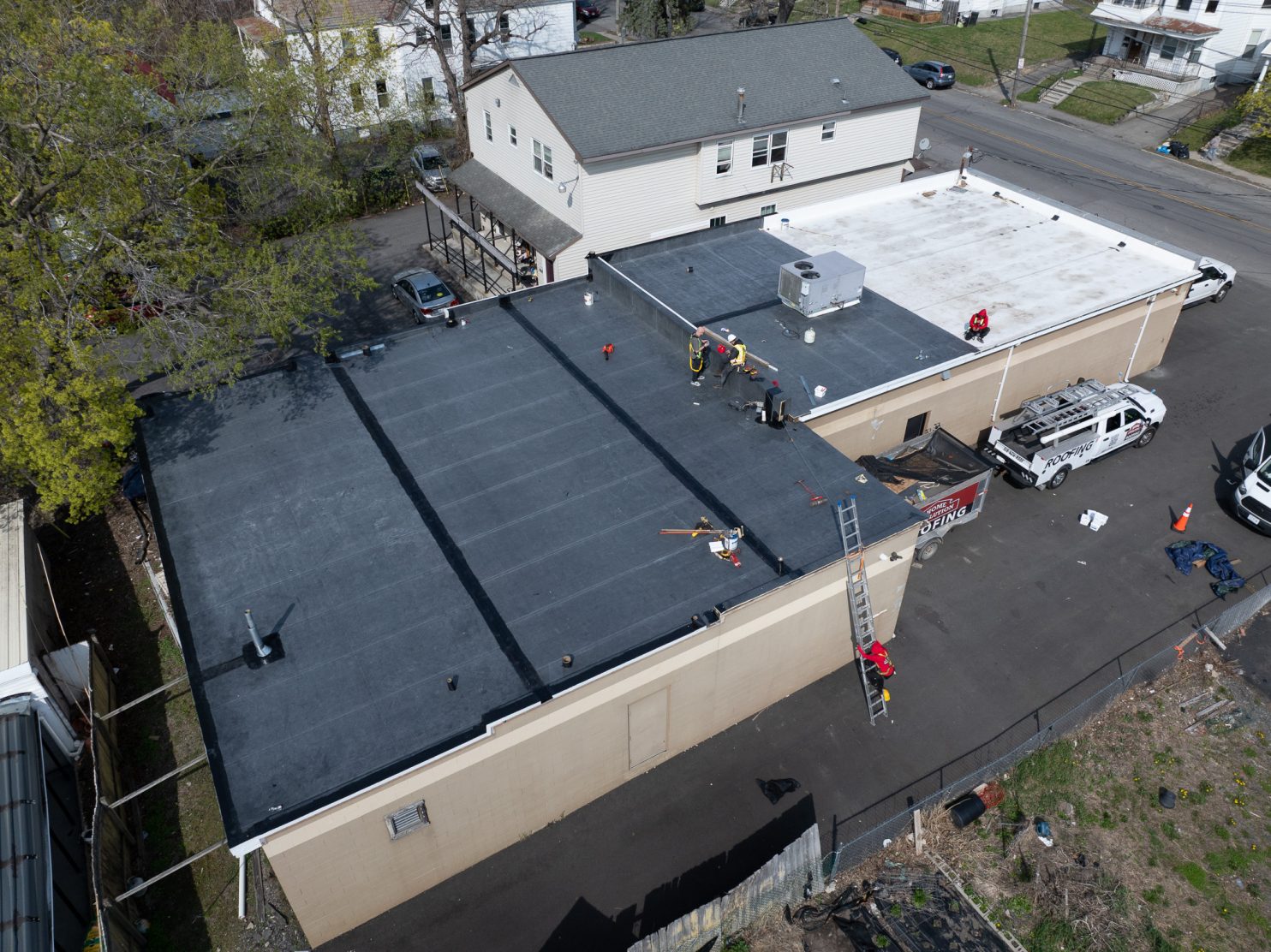
Low-Slope Roofing in Cheyenne, WY
A roof scope for Low-Slope Roofing has to start with what the building is doing today. We consider Frontier Mall and nearby service buildings, snow drift at parapets and rooftop units, Capitol Avenue office buildings, and F.E. Warren Air Force Base area contractors before we recommend work.
That keeps the scope tied to the roof that is actually on the building: membrane condition, seams, metal, drainage, rooftop units, access, tenant needs, and timing.
Low-slope roofing, any roof with a pitch below 2:12, dominates Cheyenne's commercial building inventory. Office parks along Dell Range Boulevard, retail centers near Frontier Mall, flex buildings throughout the Business Parkway, and warehouse structures across North Range and Campstool all rely on low-slope membrane systems to keep water out. In most climates, a well-installed membrane on a low-slope roof is forgiving of minor drainage imperfections. In Cheyenne, it is not. The combination of overnight freezing during nearly half the year and frequent spring snowmelt events means that any water that does not drain completely from a low-slope Cheyenne roof will freeze in place, and frozen ponded water creates ice loading, membrane stress at the ice boundary, and potential structural overload that simply does not exist in warmer climates.
The drainage slope standard for low-slope commercial roofing is a minimum of one-quarter inch per foot toward drains or scuppers. In practice, many Cheyenne commercial buildings were constructed with inadequate structural slope, and the roof membrane is installed on a nearly flat deck that relies on drain placement alone to move water off the roof. When drain placement is adequate and drains are functioning, this can work acceptably. When drains are even partially blocked, or when the roof area served by a single drain is too large for the drain capacity, water accumulates in low spots. In Cheyenne, that water freezes the same night. Ice over a blocked drain creates a dam that prevents drainage during subsequent melt events, building up a deeper pool that freezes again the following night.
Tapered insulation is the primary engineering solution for drainage problems on Cheyenne low-slope roofs. By installing polyisocyanurate insulation in tapered panels that slope toward drains or toward perimeter scuppers, we create positive drainage slope within the roof assembly without requiring structural modifications to the deck. Tapered insulation systems for Cheyenne commercial buildings require careful design, drain placement optimization, transition slope calculations, and thermal performance accounting for the varying insulation thickness across the tapered field. The result is a roof that drains completely after each precipitation event and eliminates the ponding-freeze cycle that shortens membrane life and creates structural risk.
Drain placement on existing low-slope Cheyenne roofs is often a compromise between ideal drainage geometry and the structural limitations of where roof drains can practically be located. A drain must connect to a leader that runs through or below the building structure, adding new drains to an existing building requires core drilling and plumbing work that adds cost but is often justified by the drainage improvement it achieves. On large Campstool and North Range warehouse buildings that were built with inadequate drain counts, adding drains during a planned re-roofing project is the right time to address the problem, the additional cost is modest relative to the total re-roofing investment and eliminates the most common failure mechanism on these buildings.
Membrane selection for low-slope Cheyenne roofs should account for ponding water exposure, since even well-designed drainage systems can have temporary ponding during heavy precipitation events before water clears the drains. EPDM and TPO both perform acceptably in occasional ponding contact, but silicone fluid-applied coatings are actually superior in this regard, silicone is inherently resistant to ponding water and does not degrade under sustained water contact the way that some acrylic-based coatings do. For buildings with chronic drainage issues that cannot be fully resolved by drain additions, silicone is often the right membrane choice regardless of other considerations.
Parapet wall height on low-slope Cheyenne commercial buildings affects drainage behavior significantly. A parapet that extends 18 to 24 inches above the roof membrane creates a basin effect in which wind-blown snow accumulates against the parapet and melts slowly in spring, creating sustained water levels at the parapet base. Base flashing at the parapet-to-roof intersection must be detailed and maintained to handle this condition, low-slope roofs with tall parapets and inadequate base flashing height are a recurring source of interior water damage on Cheyenne commercial buildings. We address base flashing height and condition as part of every low-slope roofing assessment.
The energy performance of low-slope roofs matters increasingly in Cheyenne's climate. White reflective membranes like TPO and PVC reduce cooling loads in summer months, but Cheyenne's heating-dominated climate means the thermal benefit of a well-insulated roof assembly matters more over the full year than surface reflectivity alone. Current Wyoming energy code requires minimum insulation levels that, when achieved with quality polyiso installation, can meaningfully reduce heating energy costs in large commercial buildings. Re-roofing projects that also bring insulation to current code levels have a real energy payback that should be factored into capital planning decisions.
Low-slope roofing warranties from leading manufacturers require specific installation conditions and quality control procedures that protect the building owner's investment. Wind speed restrictions during installation, temperature minimums for adhesive application, seam testing requirements, and inspection protocols are all part of warranted system installation. In Wyoming's unpredictable climate, scheduling warranted installation requires flexibility and weather monitoring, a day that starts warm and dry can turn to wind and cold by afternoon, requiring work stoppage to protect membrane adhesion and seam quality. Contractors who push through adverse conditions to meet schedule milestones create warranty compliance problems that building owners discover only when a claim is submitted.
Cheyenne commercial property owners with low-slope roofs should understand that drainage performance and freeze-thaw impact are the primary life-limiting factors in this climate, more so than UV exposure or general weathering. A drainage audit is a valuable starting point for any low-slope roof that has not been recently assessed, particularly for buildings over ten years old where original drain placement may never have been adequate for the actual roof area served. We provide drainage assessments as standalone services and as part of broader condition reports, and we can model proposed drain additions or tapered insulation re-slopes to demonstrate the drainage improvement before construction begins.
Questions Owners Ask
How much slope does a low-slope Cheyenne commercial roof actually need?
The industry standard minimum is one-quarter inch per foot toward drains or scuppers. In Cheyenne's freeze-thaw climate, achieving this minimum everywhere on the roof is more important than it would be in a warmer region, even small low spots that pond a half-inch of water create ice that damages the membrane and can build into significant ice accumulations over a winter. Buildings with structural slope less than this minimum should be evaluated for tapered insulation or drain additions to achieve adequate drainage geometry.
What happens to ponded water on a Cheyenne roof that does not drain overnight?
It freezes. At Cheyenne's elevation with 170-plus days below freezing, water remaining on a roof surface after a precipitation event will typically freeze during the following night from October through April. The ice exerts stress on the membrane at its perimeter boundary, adds structural load to the deck, and creates a drainage dam that prevents subsequent melt water from clearing. Over a winter with multiple freeze-thaw cycles, this process creates cumulative membrane stress and can cause structural overload at low points if ice accumulation is significant.
Is tapered insulation expensive compared to flat insulation?
Tapered polyiso costs more per square foot than flat insulation, with the premium depending on the degree of slope change required. On a typical Cheyenne commercial re-roofing project, a tapered insulation system might add 15 to 25 percent to insulation costs compared to flat board. However, that cost should be weighed against the reduction in drainage-related membrane failures, the elimination of ice loading, and the energy code compliance improvement that often comes with a properly designed tapered system. For buildings with known drainage problems, the tapered insulation investment typically pays back within the first five years in avoided maintenance costs.
My building has four roof drains for a 30,000-square-foot roof. Is that adequate?
At 30,000 square feet, four drains means each drain serves 7,500 square feet of roof area. Whether that is adequate depends on drain size, roof slope, and the rate at which water can clear during a peak precipitation event. In Cheyenne, where a one-inch-per-hour rain event combined with snowmelt can generate significant drainage demand, undersized or inadequate drain counts create ponding conditions that freeze overnight. We can evaluate your specific configuration and drainage geometry to determine whether your drain count is adequate for your actual roof area and precipitation design parameters.
Can a flat roof in Cheyenne ever truly drain completely?
Yes, but it requires intentional design. A roof with adequate structural slope or tapered insulation directing water to properly sized and placed drains will drain within two to four hours after precipitation ends. The key is that every point on the roof must have a positive drainage path, no flat or back-sloped areas where water can collect. On older Cheyenne buildings where structural slope was minimal, achieving complete drainage requires tapered insulation, drain additions, or both. It is achievable and worth doing, because a roof that drains completely is a roof that will not suffer freeze-thaw damage at low points over its service life.
Related Roof Work
Useful next pages for this roof decision.

Auto Dealership Roofing
Auto Dealership Roofing is scoped around snow drift at parapets and rooftop units, Capitol Avenue office buildings, and F.E. Warren Air Force Base area contractors. The scope stays practical: stop water first, document the roof, then choose the repair or replacement path that fits the building.
View Scope
Building Envelope Waterproofing
Building Envelope Waterproofing is scoped around Capitol Avenue office buildings, F.E. Warren Air Force Base area contractors, and freeze-thaw cycles after spring storms. We keep access, weather windows, and tenant disruption in the plan before crews step onto the roof.
View Scope
CAPEX Roof Planning
CAPEX Roof Planning is scoped around Capitol Avenue office buildings, F.E. Warren Air Force Base area contractors, and freeze-thaw cycles after spring storms. Every recommendation is tied to observed conditions, not a prewritten roof package.
View ScopeGet the roof decision into writing.
Tell us what changed on the roof, where the building sits, and who needs the report. We will turn the next step into a clear scope.